# Eau de Parfum vs Eau de Toilette: What the Labels Actually Tell You
Eau de Parfum and Eau de Toilette are useful descriptors, not a universal promise of strength. Learn how to compare the two versions of a fragrance before buying.
Canonical: https://massoedition.com/journal/eau-de-parfum-vs-eau-de-toilette/
Author: MASSO Editors
Format: Guide
Published: 2026-11-20T00:00:00.000Z
Updated: 2026-11-20T00:00:00.000Z
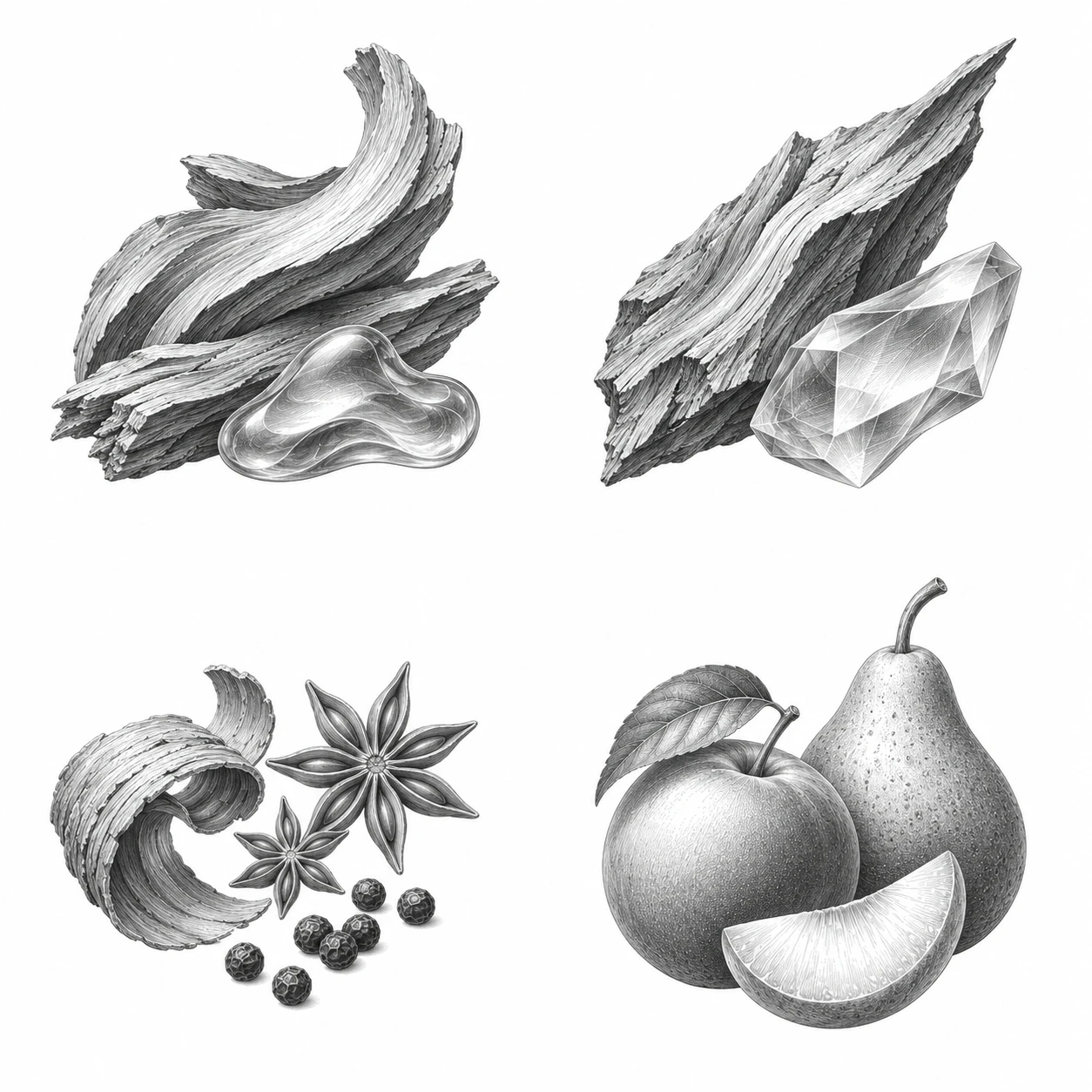
A MASSO Edition study of perfume structure; a concentration label is only one part of the whole composition. Image provenance: editorial.
## At a glance
- Labels: Common industry descriptors, not universal legal concentration tiers
- Best comparison: Test the exact Eau de Parfum and Eau de Toilette separately
- Do not assume: Eau de Parfum always lasts longer or smells identical
The short answer is that **Eau de Parfum (EdP)** and **Eau de Toilette (EdT)** are useful labels, but not a universal ranking of good, better and best. An Eau de Parfum is not automatically the “stronger version,” and an Eau de Toilette is not automatically a weaker copy.
When a fragrance comes in both, treat them as two related scents that need two separate tests. They may share a name and an idea while giving different weight to different parts of the composition.
## What the labels usually mean
In everyday fine-fragrance language, the labels describe the amount of fragrance concentrate used in an alcohol-based finished product. IFRA gives common industry ranges of roughly 5–15% for Eau de Toilette and 10–20% for Eau de Parfum. But it also makes the essential point: these terms are not strictly defined by international standards, and their use can vary by region and market segment.
That means the number on a bottle is not a portable performance guarantee. Two houses can use the same label differently. Even within one house, a newer edition can be built differently from an earlier one.
## Why an EdP may not be the same scent turned up
Sometimes an Eau de Parfum is a more concentrated interpretation of an Eau de Toilette. Sometimes it is recomposed. A house may bring a base accord forward, make a flower more enveloping, soften a sharp opening, add a new material or alter the balance between notes.
Diptyque’s own comparison puts this clearly: the two concentrations can tell the same olfactory story while being different expressions of it, rather than one simply containing more of the other. That is the right way to shop a pair. Ask which expression you prefer, not only which one has a higher label.
## Does Eau de Parfum always last longer?
No. Higher concentration can contribute to a denser or longer-lasting impression, but it is only one part of the formula. Volatility, the particular materials in a composition, your skin, temperature, application and how closely you are smelling all change the result.
An Eau de Toilette can feel beautifully present because it keeps a bright opening alive. An Eau de Parfum can sit closer than expected because its materials are soft or diffusive rather than loud. Neither outcome means the bottle is wrong.
So skip the shortcut of buying EdP for longevity alone. If longevity is your real question, test the exact version on your own skin and return to it later. If the sensation is all that matters, choose the one you want to smell again.
## How to compare an EdP and an EdT properly
Start with blotters if you need a first orientation. They make it easier to compare the opening side by side. Then put one concentration on one wrist and the other on the other wrist — on a day when you are not wearing anything else. Do not spray them on the same spot.
Pay attention to three moments:
- **The opening:** does one feel brighter, more transparent, more citrus-led or more airy?
- **The middle:** does a flower, spice, wood or fruit change position between the two versions?
- **The dry-down:** which one leaves the texture you actually want to live with?
Give each version time. A fragrance can make its strongest argument after the moment most people decide that they already understand it.
## Which one should you choose?
Choose Eau de Toilette if you prefer a fresher, more luminous or more fleeting interpretation of the idea. Choose Eau de Parfum if you prefer a deeper, rounder or more enveloping one. But choose neither on the label alone.
There is no universally correct choice, no matter how many concentration charts say otherwise. The worthwhile answer is more specific: which concentration feels like the fragrance you wanted in the first place?
## A note for buying online
When shopping online, make sure the concentration is written in full in the title and product details. A familiar fragrance name can exist as an EdT, EdP, extrait, eau de cologne, refill or different regional edition. Compare the concentration, the size and the current note description before assuming that two listings are interchangeable.
If both versions are available, sample first. The small amount of patience required is usually cheaper than trying to solve a fragrance mismatch with a full bottle.
A fragrance’s character depends on its whole construction, not concentration alone.
The same concentration label can hold very different olfactory ideas.
## Sources
- IFRA — using the standards and common fine-fragrance ranges:
- Diptyque — Eau de Parfum and Eau de Toilette comparison: